
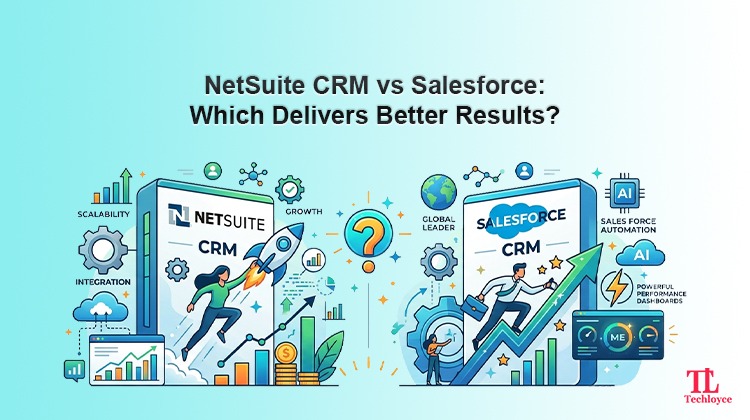
CRM is the foundation of contemporary business operations, determining how companies deal with customers, sales, and expansion. With so many options in hand, opting for the right system has become increasingly complex. Among all the software comparisons businesses explore today, NetSuite CRM vs Salesforce CRM is one of the most discussed.
At first glance, both solutions seem to address the same issue. Nonetheless, to determine which one fits best, one must go beyond surface-level feature comparison. The decision between NetSuite CRM vs Salesforce is not just about selecting a tool for your sales team; it’s about choosing a philosophy on how your business data flows. One is entrenched in a single ERP ecosystem, and the other has established its dominance through specialised CRM functions and a broad cloud platform.
This comparison evaluates both platforms in depth, examining technical capabilities, architecture, performance, usability, and applicability in practice. Let’s dive into the core features of both platforms to assess which one suits your business better.
Platform Philosophy and Core Approach
The main distinguishing element between Salesforce and NetSuite is their philosophy. Salesforce is primarily built as a CRM platform. Its main power is managing customer communications, sales pipelines, and marketing automation in a highly custom cloud environment. Over time, Salesforce has established a broader ecosystem with modules such as Sales Cloud, Service Cloud, and Marketing Cloud, but its core is CRM.
NetSuite, however, is essentially an ERP system with CRM being included in its unified suite. The main difference is critical. NetSuite CRM does not exist separately; it is closely connected with the financials, inventory, order management, and e-commerce. This implies that customer information is intrinsically linked to operational and financial information in real-time.
In simple words, Salesforce is just a CRM, while NetSuite is a comprehensive ERP solution in which CRM is one of its components. This is a point that readily sets NetSuite CRM and Salesforce apart in the eyes of businesses considering the two. Salesforce excels in customer-focused workflows, while NetSuite provides a holistic business management environment where CRM is a subset of a bigger system.
System Design and Data Flow
Technically, architecture is one of the most significant factors differentiating between two software. Salesforce is based on a multi-tenant cloud platform that has metadata-driven models. Its platform, alternatively known as the Salesforce Platform (formerly known as Force.com), enables developers to define objects, fields, workflows, and automation through their declarative or programmatic methods, such as Apex and Lightning Web Components. This adaptability renders Salesforce very flexible to intricate and dynamic business procedures.
NetSuite also deploys a multi-tenant cloud architecture but focuses on a single data model across all modules. CRM data, financial records, inventory information, and transactional information are all stored in a unified system. This removes the hassle of synchronisation among independent systems and the possibilities of data inconsistency.
Salesforce is more flexible and extensible, whereas NetSuite is more tightly coherent and has fewer integration dependencies.
Core Features and Functional Capabilities
Salesforce provides a very sophisticated CRM toolkit in terms of features. This includes improved lead and opportunity management, AI-driven analytics via Einstein Analytics, workflow automation, territory management, and advanced reporting capabilities. Additionally, Salesforce is user-friendly with even the most complicated sales methodologies and extensive enterprise-level implementations.
NetSuit CRM features support basic CRM functions such as lead tracking, sales forecasting, marketing automation, and customer support. However, its actual strength lies in combining these features with overall ERP processes. For instance, the sales teams can access real-time financial information, order history, and billing information directly within the CRM interface.
Side-by-side comparison of core CRM features is:
- Lead management: Salesforce has advanced scoring, social tracking, and deep activity history. NetSuite offers basic tracking.
- Opportunity Management: Salesforce enables hyper-customisable pages, split-credit, and complex deal logic. However, with NetSuite, there’s a direct link from opportunity to sales order and fulfillment.
- Forecasting: Salesforce utilises predictive AI on the basis of previous sales patterns, while NetSuite uses real-time inventory levels and revenue schedules.
- Email Marketing: Salesforce has multi-step “journeys” with high-volume automation. NetSuite offers standard campaign tools with direct ROI tracking on orders.
- Customer Support: Salesforce features highly branded portals for resellers and distributors. NetSuite, on the other hand, conducts case management with full visibility into billing and shipping.
Here, the NetSuite CRM vs Salesforce comparison relies on priorities. Salesforce is a more appropriate choice for businesses that want to streamline their sales and customer interactions with the sole aim of maximising sales and customer retention. NetSuite is favoured by those who seek improved visibility.
User Experience and Interface Design
Another important consideration while comparing software is ease of use. Salesforce has invested heavily in “lightning experience,” a modern, component-based interface. It is user-friendly and can be customised. It is built to aid productivity with dashboards, drag and drop elements, and contextual data views.
The interface of NetSuite can be considered more utilitarian than functional. It prefers efficiency over design. This is highly advantageous to the users accustomed to ERP systems, as they can access detailed information quickly. However, a steeper learning curve can be experienced by new users.
Practically, Salesforce has an advantage in terms of user experience and ease of onboarding, whereas NetSuite attracts users who are less interred in the interface aesthetics and more in the integrated processes.
Customisation and Extensibility
One of the strengths of Salesforce is customisation. Its ecosystem enables businesses to customise almost all features of the platforms. Organisations can utilise tools such as Process Builder, Flow, and Apex to automate workflows, develop custom objects, and build complex business logic. The AppExchange marketplace also extends the functionality to thousands of third-party applications.
NetSuite is also customisable using SuiteScript, SuiteFlow, and SuiteBuilder. Although they are powerful, these tools are more limited than the platforms offered by Salesforce. The customisation method of NetSuite can be adequate for typical business processes, but may involve more work when it comes to highly specialised applications.
In the NetSuite CRM vs Salesforce CRM comparison, Salesforce leads in extensibility. However, in most cases, NetSuite does not require customisation because core business processes are already implemented into the system.
Integration and Ecosystem
The ability to integrate is essential in contemporary software environments. Salesforce provides an extensive range of integrations via APIs and AppExchange. It is compatible with virtually any third party system, and thus is suitable in organisations with diverse stacks.
NetSuite also has APIs and integration tools, but is built with the purpose of reducing the need of integrations. It has a suite of ERP, CRM, and eCommerce etc in one platform. This makes the process of internal integration simpler, but potentially constraining to organisations that are dependent on specialised tools.
Comparing Salesforce and NetSuite CRM, the decision usually hinges upon the preference of a business to follow a best-of-breed strategy or an all-in-one solution.
Performance and Scalability
Both are highly scalable; however, they scale differently. Salesforce is designed to process high amounts of customer data and sophisticated processes at global companies. It has a high availability, high security, and performance optimisation infrastructure to support large scale deployments.
NetSuite also has the ability to scale effectively, especially for growing firms transitioning from mid-market to enterprise levels. Its cohesive structure guarantees homogeneity of data across modules. However, it can not be as flexible as Salesforce in addressing complex CRM-specific situations.
Businesses comparing both platforms must focus on whose scalability aligns more with their growth patterns.
Pricing and Total Cost of Ownership
Salesforce has a per-user, per-month pricing and includes tiered pricing. Costs can rise significantly by having advanced features, integration, and third-party software applications.
NetSuite is generally sold as a subscription-based model and comes with different modules. Even though this upfront cost will be higher, it can actually be cheaper for companies that require both CRM and ERP functions.
The total cost of ownership depends on the customization, deployment, and maintenance. Salesforce may require higher costs when it comes to integration, while NetSuite costs more during deployment.
Reporting and Analytics
Salesforce provides powerful analytics through its reporting features and Einstein AI. Users are able to develop elaborate dashboards, predictive models, and real-time insights that meet the requirements of any given business.
NetSuite, on the other hand, offers good reporting features, especially in the financial and operational environment. Its analytics are closely bound with ERP data, which provides extensive business insights.
Salesforce is better than NetSuite CRM when it comes to customer-centric analytics, whereas NetSuite offers a wider business insight.
Security and Compliance
Both platforms are security and compliance-focused by offering features such as role-based access control, data encryption, and audit trails. Salesforce has established a good reputation in adhering to the international standards and offering extensive security customisation.
NetSuite also complies with high security standards and has the advantage of its unified architecture that minimises fragmentation and possible vulnerabilities.
In the case of most organisations, both platforms are secure enough, making it a less distinguishing variable in the NetSuite CRM vs Salesforce comparison.
Which Businesses Should Choose Salesforce
Salesforce is ideal with companies that value customer interaction, need a high degree of customization, and work in a complex sales environment. It is especially useful with big companies that have their own IT teams. Key industries utilising Salesforce are:
- Manufacturing
- Financial services and banking
- Retail and e-commerce
- Healthcare and life sciences
- Non-profit and education
- Auto dealership
Which Businesses Should Choose NetSuite
NetSuite suits best to those companies that are interested in a combined system of CRM and ERP. It is particularly useful to businesses that require real-time access to financial and operational information as well as customer communications. Top businesses and industries using NetSuite are:
- Software and services (SaaS)
- Fast-growing startups and high-growth companies
- Global/ multi-entity enterprises
- Multi-channel sales e-commerce
How to Successfully Migrate Your CRM System
Techloyce aids companies in the smooth transition to CRM platforms like NetSuite and Salesforce by managing the whole transition process, including data extraction, structured migration, and system configuration. Its certified CRM specialists can make sure that sophisticated data in legacy systems are properly transferred without loss or inconvenience.
Additionally, it ensures that workflows, modules, and integrations are aligned to the architecture of the target platform. It also offers post implementation support, training as well as customisation together with migration to ensure teams are fully adapted to the new system and maximise its operational potential.
Final Verdict
The ultimate choice between NetSuite CRM vs Salesforce CRM depends on your business priorities. Salesforce is a high-potential, scalable CRM solution that has unparalleled customisation and ecosystem support. NetSuite, meanwhile, is a single platform that combines CRM and business operations, offering complete visibility into your company.
Salesforce can be a better fit for those businesses that are more concerned with the optimisation of sales and customer interaction. NetSuite is a potential alternative for those who need operational efficiency and integration of data across departments.
If you are evaluating NetSuite CRM vs Salesforce and still unsure which platform fits you best, the right implementation strategy can make all the difference. Techloyce helps businesses choose, implement, and optimise the right CRM solution. Connect with Techloyce to build a CRM system that addresses your operational needs and ensures that there’s a smooth, scalable digital transformation for your business.