
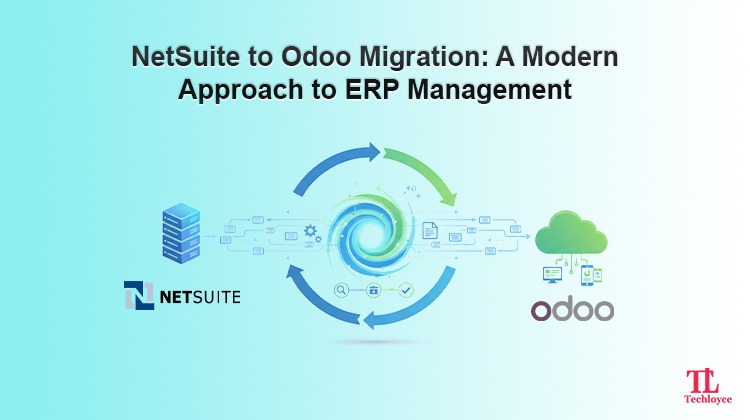
Enterprise resource planning (ERP) lays the foundation of a successful modern business. It is responsible for managing finance, sales, inventory, HR, operations, and customer data in one place. For years, businesses have relied on NetSuite. However, modern businesses have found it outdated. It is not because the technology is obsolete, but because its architectural philosophy, user experience, and cost model are struggling to meet the requirements of modern, agile businesses. Odoo stands out as a good alternative for modern businesses that are exploring more flexible and cost-effective solutions.
Migrating from NetSuite to Odoo is a strategic decision. It yields many benefits, including a reduction in costs, improvement in overall business operations, and elimination of vendor lock-in. However, it is important to carry out the migration carefully. Techloyce can help you make your transition journey smooth, secure, and successful.
NetSuite vs Odoo
Both NetSuite and Odoo are trusted choices for many businesses worldwide. NetSuite is a robust, premium cloud ERP that is built to cater to medium-sized to large enterprises needing complex, global or highly standardised operations. In comparison, Odoo is a flexible, modular, and cost-effective open-source ERP suitable for small-to-medium businesses seeking rapid development and high customisation.
In short, NetSuite offers stronger, all-in-one financial features, while Odoo provides better and modern user interfaces.
Why Businesses Are Moving from NetSuite to Odoo?
Before switching platforms, it is important to discuss why the NetSuite to Odoo migration is necessary.
High Licensing Costs
NetSuite is a subscription-based software. Companies are charged per user or per module which is costly. The prices rise tremendously as the teams expand. Further customisation and support are also paid features that make the overall cost daunting. On the other hand, Odoo has a community edition that is free of charge. Its enterprise edition is also priced competitively, ideal for SMEs and businesses that are currently growing as they have to only pay based on their usage.
Limited Customisation Flexibility
NetSuite customization may only involve certified partners and is costly. The open-source architecture of Odoo can be customised completely. Businesses have the opportunity to alter processes including new modules, and create brand new applications based on specific requirements.
Vendor Lock-In
Under NetSuite, the companies are bound to Oracle’s cloud infrastructure. Odoo, on the other hand, offers various deployment modules: cloud, on-premises or hybrid. This scalability guarantees total data and hosting control.
Prerequisites for NetSuite to Odoo Migration
Migration is not only a technical shift but a business movement. Therefore, NetSuite to Odoo migration needs to be planned carefully to reduce the impact and to ensure that operations proceed successfully. Systematic strategy mitigates risk and sets a clear roadmap to follow.
Audit Your Current System
To start with, a detailed audit of your current NetSuite environment should be performed. List all the active modules in operations such as finance, inventory, CRM, and HR. Store custom scripts, workflows, and third-party integrations to support daily operations. Check reporting structures and dashboard to set similar functionality in Odoo. Prior audit helps to avoid missing any crucial point and builds the foundation for your migration blueprint.
Define Business Objectives
Before you start the migration, it is important that you state what you want to achieve. Decide whether your objective is cost reduction, better reporting, increased automation or better CRM integration. Determine some quantifiable results that are used to measure post implementation success. With clearly defined objectives, there is better coordination between teams with meticulously assigned roles
Clean and Prepare Data
One of the most important steps during ERP migration is the data preparation. Delete duplicate data, fix inconsistencies, and standardise data formats. Clean data helps to make imports in the new systems easier and proper reporting smoother.
System and Functional Analysis
Evaluate all NetSuite customization such as scripts and workflow and determine which are necessary in Odoo or can be substituted with standard features to minimise complexity in the long-term. Define user permissions and roles in detail to the security groups of Odoo to ensure appropriate access control.
Common NetSuite to Odoo Migration Challenges
Despite adequate planning, one can still meet certain difficulties during migration.
Data Structure Differences
The data in NetSuite and Odoo are structured in a different manner, including custom records, inventory items, and financial transactions. Therefore, it is important to map these structures properly. Any discrepancy may result in reporting errors, loss of records, or operational interruptions after migration.
Financial Configuration Alignment
Both systems differ in charts of accounts, taxation regulations, fiscal periods, and multicurrency management. When organisations have several subsidiaries or work across many countries, planning is crucial in replicating complex financial structures. Even minor mistakes in revenue recognition and intra-company transactions may lead to compliance risks.
Reporting Reconstruction
NetSuite’s reports, dashboards, and saved searches can’t be directly migrated. All the reports need to be recreated in Odoo with high accuracy of calculations, filters, and relations of data. Without attention, the businesses can risk losing historical insights and consistency of decision-making.
Customisation and Workflow Migration
Workflows, SuiteApps, and custom scripts in NetSuite do not always have direct equivalents in Odoo. Their reconstruction needs a profound insight into the logic of both systems. Poor copying can result in the loss of automation or leads to duplication of the process.
Infrastructure and Performance
The performance of Odoo heavily relies on correct hosting, server sizing, and optimisation of the database. Failure to estimate these requirements correctly may lead to slow response time, system errors, and frustrate users.
Process Standardisation
Migration reveals workflow inconsistency between departments. There is a need for organisational coordination and leadership involvement within Odoo to meet the requirements of alignment of processes including procurement, sales approvals, and inventory management.
Change Management and Training
The transition to Odoo can be tricky in terms of adapting to the modular interface and functionality of the platform. The adoption of the new ERP can be slow without structured training, gradual implementation, and clear documentation. It ultimately affects productivity and system reliability.
How to Overcome NetSuite to Odoo Migration Challenges?
The transition from NetSuite to Odoo can be complicated than it may seem. Especially in absence of an experienced Odoo implementation partner like Techloyce, the process is quite tricky. Despite positioning themselves as powerful ERP systems, both vary dramatically in their architecture, customisation models, data structures, and flexibility in deployment. Migration does not only involve changing software, it’s about optimising your business processes. This is where Techloyce stands out.
It overcomes all challenges faced during ERP migration by simplifying the migration process, handling data mapping, workflow customisation, and system integration ensuring a smooth and efficient transition.
Ensure a Successful NetSuite to Odoo Migration with Techloyce
Switching to a modern ERP is necessary to meet the requirements of an evolving business environment. With proper planning, structured execution, and expert guidance, this transition can be highly advantageous.
Techloyce combines deep ERP knowledge, CRM consulting expertise, and customised integration capabilities to deliver maximum business value. If you are considering NetSuite to Odoo migration, now is the time to evaluate your goals and understand your business needs. Your ERP transformation journey begins with the right strategy and the right partner.