
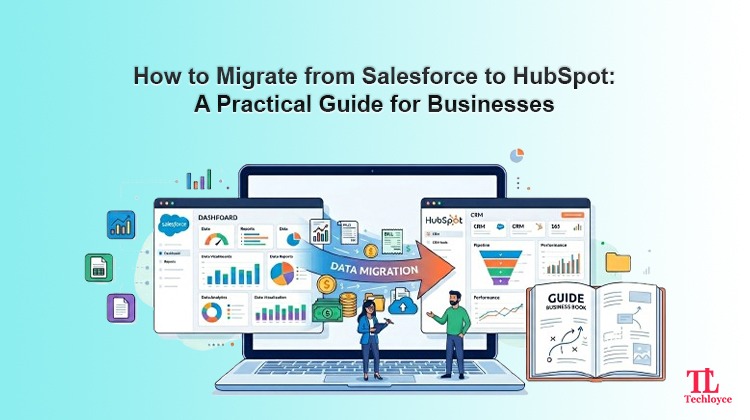
In the contemporary business environment, companies are constantly looking for solutions that enhance their efficiency, scalability, and customer experience. Moving from Salesforce to HubSpot is one of the most frequent changes that companies look forward to.
If you are also wondering how to migrate from Salesforce to HubSpot, you are not alone. Many organisations relying on Salesforce encounter common problems. Despite being effective, Salesforce becomes too complicated, costly, and hard to manage without specific technical resources. HubSpot, however, is a more friendly, well-integrated, and affordable CRM ecosystem.
However, the migration process involves much more than transferring data. Partnering with Salesforce to HubSpot migration experts like Techloyce, businesses can successfully have error-free transitions. With custom CRM migration solutions, Techloyce helps businesses maintain data accuracy while optimising workflows.
Why Businesses Are Migrating From Salesforce to HubSpot
Before migrating, there’s a need to understand why Salesforce falls short. Many companies that have HubSpot migrated from Salesforce report significant benefits, including:
Simplicity and Ease of Use
Salesforce is very versatile; however, this can be at the expense of usability. HubSpot has a simple, easy to use interface that lets teams start with the minimal training required.
All-in-One Platform
HubSpot is a combination of marketing, sales, customer service, and CMS tools into a single system. Companies do not have to use several integrations to handle their operations.
Lower Total Cost of Ownership
Salesforce can demand extra licenses, developers, and third-party tools. HubSpot, on the other hand, is transparent in pricing and relies less on third-party resources.
Step-by-Step Guide: How to Migrate from Salesforce to HubSpot
The shift from Salesforce and HubSpot is a complicated process that should involve careful planning, execution, and optimisation. The individual stages of the migration play a specific role in ensuring data integrity and reducing the number of disruptions. The following is a deconstruction of the migration process into actionable steps.
Planning and Assessment
The initial part of any successful migration is the proper planning and evaluation of your existing CRM environment. It involves assessing the current Salesforce data to analyse what are the requirements and goals of the migration. It helps to establish a clear roadmap to understand what goals can be achieved after migration.
Data Cleanup and Preparations
It is necessary to clean and arrange your existing records before you transfer any data. The Salesforce databases gradually tend to get multiple entries, obsolete data, and irregular formatting. The transfer of such data may cause inefficiencies and errors in your new system.
Data Mapping Between Salesforce and HubSpot
Every single object and field in Salesforce should be well-matched with its equivalent in HubSpot. With the help of effective mapping, businesses can ensure that there’s no loss of essential data. Additionally, mapping also brings uniformity to existing data.
HubSpot Setup and Configuration
The next step is to set up your HubSpot environment to suit your business requirements when your data is ready. This involves configuration of user roles, pipelines, custom properties, as well as automation workflows. Instead of replicating the Salesforce data exactly, this is an opportunity to streamline and optimise your processes.
Test Migration
Test migrations should be carried out on a small dataset before a full-scale migration is implemented. This enables you to detect and fix any problems concerning the accuracy of data, its formatting, or relationships. Testing is a kind of safety net, and it makes sure that your migration strategy is good. It also offers a chance to make some corrective adjustments and improve your strategy.
Full Data Migration
Once testing is done, you can continue the migration. It should follow a systematic process to ensure the relationships and integrity of data. Businesses should closely monitor at this stage to observe whether there are any discrepancies or problems in real time. The migration makes sure that your business operations process without any major interruption.
Workflow Automation
After you have migrated your data, it is time to re-establish and streamline your processes in HubSpot. This involves automating most of the major processes like lead management system, follow-ups, and deals progression. Businesses should not just imitate the existing workflows but should use the potential of HubSpot to make them more efficient. This is a necessary procedure to unlock the maximum potential of the new CRM system.
Challenges You May Face During Migration
Although the advantages are evident, CRM migration is not a one-stop shop. Businesses that have HubSpot migrated from Salesforce usually encounter:
Data Quality and Inconsistencies
CRM systems over time contain problems of duplicate, outdated, and incomplete data, which can cause problems during the migration. Unless the cleaning is done well, this data may lessen the impact of the new system. Data must be highly audited and standardised to ensure accuracy prior to transfer.
Complex Data Mapping and Relationships
Accurate mapping is a critical problem with Salesforce and HubSpot since they have different data structures. Even minor mistakes may destroy the relationship between records or cause loss of data. Data must be aligned carefully to ensure the integrity of the data.
Handling Large Volumes of Data
Companies that have a large amount of historical data usually face the challenge of handling and managing massive amounts of data. This may cause delays and performance problems without proper planning. It is important to prioritise which data needs migration or which can be archived.
Integration with Existing Tools
CRMs are often connected with various third-party tools that need to stay functional even after the migration. It is usually complicated to test those integrations post-migration. Any issue in the reconfiguration can cost businesses a huge loss.
Lack of Internal Expertise
Most organisations are not technologically familiar with complex CRM migrations. The internal teams can also be occupied with day-to-day activities and may not be in a position to oversee the process effectively. This may cause delays and mistakes.
User Adoption and Training
The employees who have been using Salesforce over the years might struggle to adjust to a new CRM system. In the absence of proper training, there can be low adoption rates and low productivity. It is necessary to assist the users during the transition.
How to Mitigate Challenges Faced During Salesforce to HubSpot Migration
From data cleanup and mapping to workflow rebuilding and integration management, every step requires precision and experience. This is where dedicated CRM migration services such as Techloyce would be very important in streamlining the whole process. As a global leader in CRM development, migration, integration, and training, Techloyce brings in-depth experience in CRM and ERP implementation, helping organisations overcome complex challenges while ensuring data accuracy, minimal disruption, and reduced manual effort. Having the appropriate support in place, organisations can reduce risks, secure continuity, and make a clean and effective transfer to HubSpot without undue delays and complications.
How Techloyce Ensures Successful Migration
While it is possible to manage migration internally, most companies do not recognise the complexity of migration. That is where Techloyce comes in. It ensures successful migration via:
- Customisation: Tailor modules for sales management, marketing automation, financial management, inventory management, project management, and human resource management to fit unique business requirements.
- Migration: Ensure smooth transfer of large volumes of data into the modern HubSpot environment.
- Integration: Connect CRM with ERP, CMS, BI, accounting systems, and other existing applications for unified and coordination operations.
- Ongoing training and support: Equip end users, managers, and administrators with practical CRM training to maximise adoption and performance.
Make Your CRM Transition Effortless
Understanding how to migrate from Salesforce to HubSpot is essential to companies that seek to streamline their operations and expand in a cost-effective manner. Although it is a process that requires many steps, its long-term advantages far exceed the difficulties.
Migration is not just a technical process but a strategic transformation. By collaborating with specialists like Techloyce, companies can make the process of migration effective, safe, and consistent with their business objectives.
If you are planning to make the switch, now is the perfect time to evaluate your CRM strategy and take the next step towards a more streamlined and growth-oriented system with HubSpot.